# 9.4.6 Chlorination as a critical control point: an example

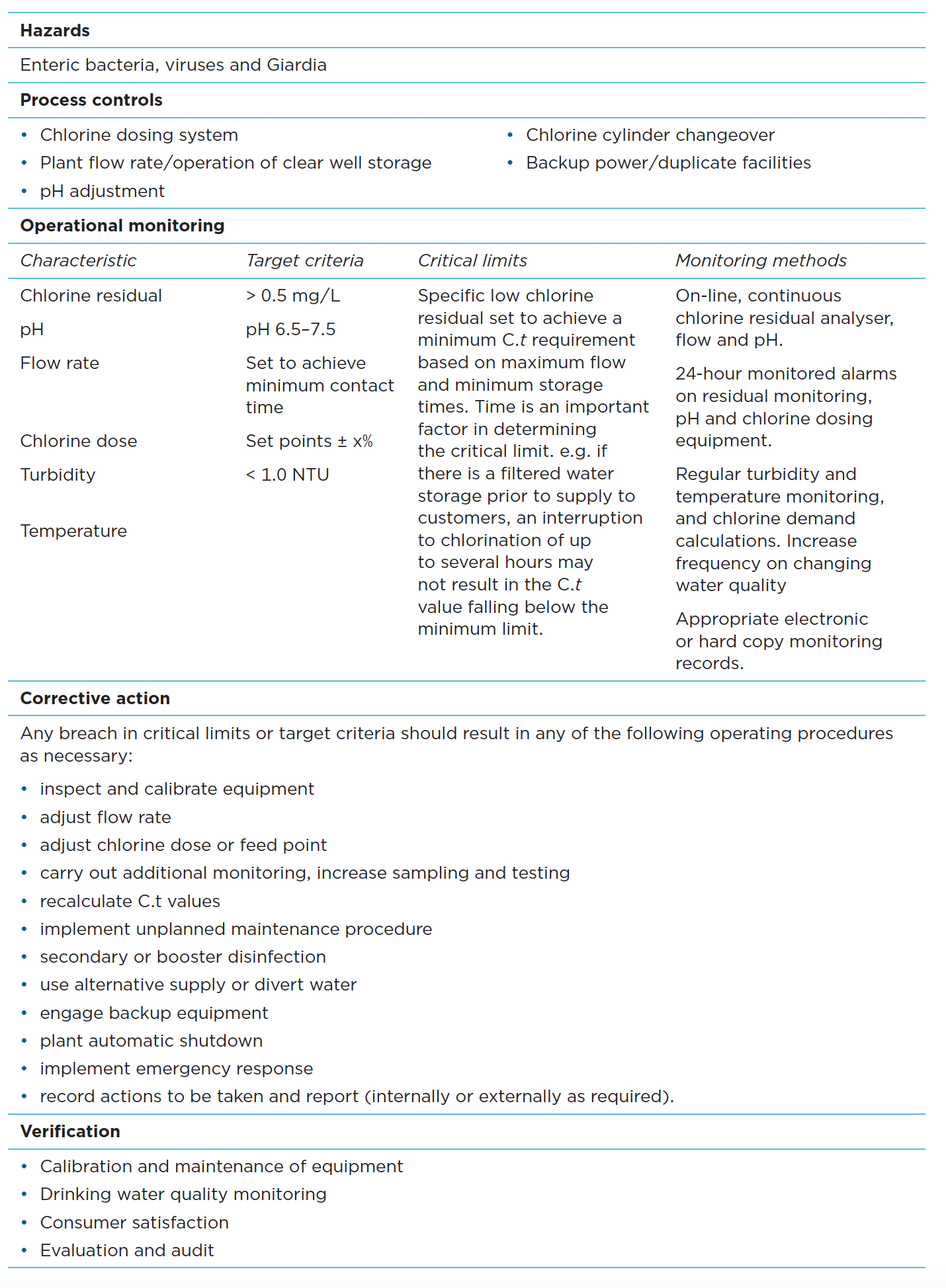
Chlorination is the most commonly used process for disinfection and is highly amenable as a critical control point. Table 9.3 outlines, as an example, the operational requirements relevant to the chlorination process as a critical control point. The requirements include monitoring the key operational characteristics of residual chlorine concentration, flow rate (contact time) and chlorine dose; and establishing critical limits and target criteria for effective operation. Turbidity, temperature and pH also require monitoring, as they influence chlorination effectiveness and the validity of C.t calculations. Corrective actions to address deviations in operating limits must be identified, and chlorination performance should be regularly verified.

Appendix A1.8 provides additional information on chlorination as a critical control point.

### Table 9.3 Example of chlorination as a critical control point <a href="#table-9-3" id="table-9-3"></a>

<figure><img src="/files/s7neX7uFYJXRIMVRKWZm" alt=""><figcaption><p>Click for a larger version. An accessible copy of this table and a high quality PDF is available at <a href="https://www.nhmrc.gov.au/australian-drinking-water-guidelines-resources#Table93">Water Quality Guidelines resources</a>.</p></figcaption></figure>

***


---

# Agent Instructions: Querying This Documentation

If you need additional information that is not directly available in this page, you can query the documentation dynamically by asking a question.

Perform an HTTP GET request on the current page URL with the `ask` query parameter:

```
GET https://guidelines.nhmrc.gov.au/australian-drinking-water-guidelines/part-3/chapter-9/9.4-operational-monitoring/9.4.6-chlorination-as-a-critical-control-point-an-example.md?ask=<question>
```

The question should be specific, self-contained, and written in natural language.
The response will contain a direct answer to the question and relevant excerpts and sources from the documentation.

Use this mechanism when the answer is not explicitly present in the current page, you need clarification or additional context, or you want to retrieve related documentation sections.
